




We want to set new standards in
digitization and are therefore conducting research in several areas to make IT climate-neutral.
We want to set new standards in
digitization and are therefore conducting research in several areas to make IT climate-neutral.
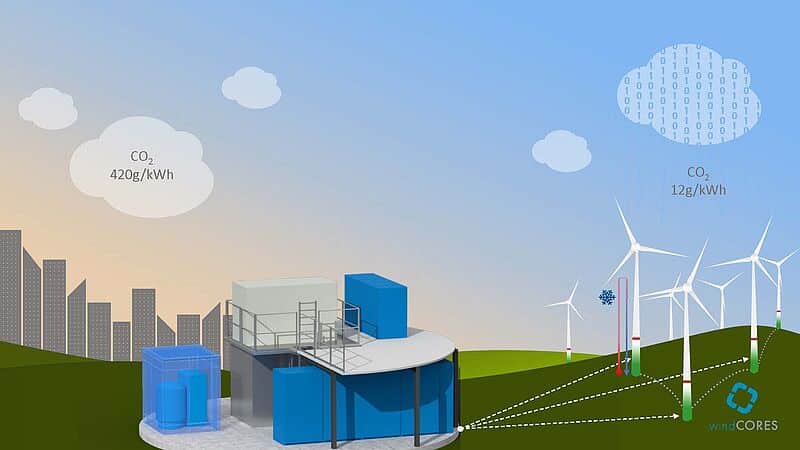
Our goal is to make digital technologies more sustainable overall. At windCORES, we are therefore focusing on several topics in order to develop climate-neutral, energy-efficient, and forward-looking IT. One focus is on high-performance computing (HPC).
Below is an overview of the research projects in which windCORES is involved.
The research project, called “IPCEI — Next Generation Cloud Infrastructure and Services (IPCEI CIS),” was initiated by seven member states. Up to €1.2 billion in public funds have been made available for the project, which is expected to unlock a further €1.4 billion in investment from the private sector. As part of IPCEI, 19 companies, including small and medium-sized enterprises, will carry out 19 highly innovative projects.
The official project name IPCEI-CIS is a little cumbersome and initially reveals little about the actual project. The last three letters are crucial: they abbreviate what it is all about: cloud infrastructures and services. According to the official announcement from Brussels, the core objective is to bring together the central and decentralized computing capacities of different players on a common open technology basis. “The participating companies will develop open-source software that enables real-time services with low latency via distributed computing resources close to the user, reducing the need to transfer large amounts of data to central cloud servers,” according to the official EU press release.
“Put simply, it’s about creating a dedicated European cloud system that is federally structured and distributed, and in which all participants can take part,” explains Fabian Löhr, the project manager responsible. He describes windCORES’ role in the project as follows: “Our task as operators of decentralized data centers in wind turbines could be to provide one of the future interfaces for energy-efficient, resource-saving, and climate-neutral operation.” Because one thing is certain: according to the EU, the project aims to do nothing less than “advance the digital and green transition in Europe.” It aims to deliver the technologies and solutions to achieve the digital strategy by 2030: the use of cloud technology by 75% of European companies and the installation of more than 10,000 supercomputers across Europe.
More about the project:
“Energy-optimized supercomputer networks through the use of wind energy” (ESN4NW): This title refers to a new, nationwide joint project led by SICP – Software Innovation Campus Paderborn at the University of Paderborn. In cooperation with WestfalenWIND IT as a member company, the idea arose to develop a new HPC infrastructure with a sustainable concept. The Federal Ministry of Education and Research (BMBF) is now funding the project for the next three years with around 2.5 million euros. The consortium also includes the University of Passau, the Fraunhofer Institute for Reliability and Microintegration IZM, and the companies AixpertSoft GmbH, Rittal, Atos Deutschland, and Zattoo.
The aim of the project is to develop the infrastructure and operational management of an HPC cluster within several wind turbines. The direct, locally available renewable energy is to be incorporated into the operational management in order to make maximum use of it. In addition, the waste heat generated is also to be taken into account as a limiting factor. Together, the consortium partners are researching and demonstrating the potential of our windCORES – wind turbines that house data centers in their towers and supply them with climate-neutral wind power generated on site.
The objectives at a glance:
More about the project on the ministry’s website:
Even small energy savings in data centers lead to significant CO2 savings. This is where the WindHPC project comes in, which aims to reduce energy consumption by improving the efficiency of simulation codes, HPC workflows, and data management. It is the first project of its kind to connect computers in wind farms with an HPC center.
The project will first examine the energy consumption of individual simulations on different hardware and at different locations using energy efficiency metrics and promote the development of digital twins for this purpose. These can then be used for more precise analysis and utilization of energy-saving potential.
Another aspect of WindHPC is the first connection of computers in wind turbines with HPC data centers. At this point, the plan is to connect computers in wind turbines belonging to our WestfalenWIND IT GmbH & Co KG, the windCORES, with the HPC computing resources of the HLRS. To make this possible, intelligent scheduling procedures are to be developed that distribute and execute the overall workflow optimally across these two resources, taking into account energy requirements and the temporal relevance of the simulations required.
In addition to us, other project partners involved are: Helmut Schmidt University/University of the Federal Armed Forces Hamburg, Technical University of Munich, Technical University of Berlin, Technical University of Kaiserslautern, University of Stuttgart (VISUS)
More on the funding objectives and further information on the BMBF website:
High and constantly growing data volumes slow down communication in the Internet of Things (IoT). Decentralized organizational and architectural approaches for communication networks, such as edge computing, which process data in geographical proximity to its source or destination, promise efficient bandwidth utilization and real-time processing. These efficiency gains through edge computing are also being exploited in sensitive and increasingly security-critical areas of application, such as energy generation. The challenge here is to protect the hardware and services used in often heterogeneous operating environments against cyberattacks. Standards, processes, and services used in conventional data centers are therefore not suitable.
The aim of the project “Cyber-physical security using radiometry for the edge” (C‑ray4edge) is to develop a technical framework to secure the operation of edge computing. The “normal operation” of a network node is recorded as a profile of its electromagnetic radiation. A comparison of profiles at different points in time is used to detect hardware manipulation. A central location can thus monitor a large number of network nodes based on the profiles created. This monitoring is supplemented by identity verifications, known as trust anchors, in the hardware. Greater system reliability is also to be achieved through the development of self-monitoring and improved resource management.
Autonomous energy management, self-diagnosis of outdated hardware, and secure and efficient update management are core components of an innovative solution, such as that to be used in the installation of data centers in wind turbines, our windCORES. The research results will be further developed by the consortium partners after the end of the project period until they are ready for market. In the future, the research results will be incorporated into the development of standards and open source systems for the IoT. These contributions are also important for the automotive industry, the energy industry, logistics, and other areas of application with sensitive infrastructures.
The goals at a glance:
More about the project on the ministry’s website:
https://www.forschung-it-sicherheit-kommunikationssysteme.de/projekte/c‑ray4edge
You are interested in our research projects? Then please feel free to contact me.
Are you interested in our research projects? Then please feel free to contact me.